Last Updated: November 21, 2026
Quick Summary
A residential roofing warranty splits into two separate documents: a manufacturer material warranty covering defective shingles, and a contractor workmanship warranty covering installation errors and labor. Read both before work begins, because a long material term paired with a short workmanship guarantee leaves you exposed on the expensive part, which is labor.
- Material warranties cover defective shingles but not the labor to remove and replace them.
- Workmanship warranties cover installation errors like improper nailing, poor flashing, or faulty ventilation.
- Storm damage, poor maintenance, foot traffic, and altered areas are common warranty exclusions.
- Prorated coverage shrinks the payout as the roof ages, while non-prorated coverage pays the full stated amount.
- Many limited lifetime and extended terms require registration within a set window and a certified installer.
Table of Contents
- The Two Roofing Warranties Every Homeowner Gets
- What a Standard Roof Warranty Covers and What It Doesn’t
- Roof Warranty Length: Standard vs. Extended Coverage
- Prorated vs. Non-Prorated and the Limited Lifetime Label
- A Real Roofing Warranty Example, Decoded Line by Line
- How Do I Find My Roof Warranty and Keep It Valid
- What Voids a Roof Warranty and How to Avoid It
- Filing a Claim and Protecting Your Coverage When You Sell
- Frequently Asked Questions
The Two Roofing Warranties Every Homeowner Gets
Every residential roof comes with two separate warranties, and confusing them is the most expensive mistake a homeowner can make. Understanding residential roofing warranty terms starts with this split: a manufacturer material warranty covers the shingles themselves, while a contractor workmanship warranty covers how those shingles were installed. A roofing warranty is only as strong as the party standing behind it, so it helps to review both documents before work begins.
Manufacturer Material Warranty
A manufacturer material warranty is issued by the shingle maker and covers defects in the roofing materials themselves, such as premature granule loss, cracking, or manufacturing flaws. It does not cover labor to remove and replace the failed product. Most require registration within a set window after installation to stay valid.
Contractor Workmanship Warranty
A contractor workmanship warranty is the roofer’s own promise covering installation errors: improper nailing, poor flashing, or faulty ventilation that leads to a roof leak. This is the warranty that pays for labor. Its length and terms vary widely by contractor, so read the fine print before signing.
| Warranty Type | Issued By | Covers | Typically Covers Labor? |
|---|---|---|---|
| Material warranty | Manufacturer | Defective shingles and materials | No |
| Workmanship warranty | Contractor | Installation errors and leaks | Yes |
What a Standard Roof Warranty Covers and What It Doesn’t
A standard roof warranty covers two things: defective roofing materials and faulty installation. That is the whole scope. It does not cover damage from storms, neglect, or anything the homeowner did after the roof went on. FTC consumer guidance on warranties is clear that warranty terms must be disclosed, so ask for the written document, not a verbal promise.
For a deeper breakdown of what a new roof warranty covers and what it excludes, review what a new roof warranty covers before you sign.
Common Exclusions and Limitations
- Storm damage: wind, hail, and falling limbs are insurance claims, not warranty claims
- Poor maintenance: clogged gutters and trapped debris that cause rot
- Foot traffic damage: cracked shingles from walking the roof
- Altered or repaired areas: work done by anyone other than the original installer
Roof Warranty Length: Standard vs. Extended Coverage
Warranty length is where homeowners get tripped up. A standard material warranty often runs a shorter coverage period, while an extended warranty lengthens the term, usually in exchange for registration and a certified installer. Workmanship coverage is separate and typically much shorter than the material term.
The practical takeaway: ask two questions. How long is the material coverage, and how long is the labor coverage? A long shingle warranty paired with a short workmanship guarantee leaves you exposed on the expensive part, which is labor.
Prorated vs. Non-Prorated and the Limited Lifetime Label
Prorated coverage means the payout shrinks over time, so a roof replaced in year fifteen pays less than one replaced in year three. Non-prorated coverage pays the full stated amount regardless of age. That one-word difference is where most of the money sits, and it is the term homeowners skim past.
Here is how the mechanism actually works. A prorated material warranty assigns a value to the shingles at installation and reduces that value on a schedule. Under a prorated term, the payout is reduced as the roof ages, so a failure late in the term may return only a fraction of the original material cost, with the homeowner absorbing the rest along with all labor. Non-prorated coverage does not reduce the payout with age for the stated term, so check the specific warranty document for its proration schedule and conditions.
A limited lifetime warranty sounds permanent but is neither unlimited nor truly lifetime. In practice it usually means three things: the coverage lasts as long as the original homeowner owns the home (or a defined number of years, whichever comes first), it covers only the specific defects listed in the document, and it excludes labor. The word “limited” is doing real work, because it signals that the manufacturer has carved out exclusions, transfer conditions, and proration rules. Read those two words, “limited” and “lifetime,” as marketing, then find the actual coverage duration, the proration start date, and the labor position in the fine print.
Three questions separate a strong term from a weak one:
- When does proration begin? A warranty that stays non-prorated for ten years is worth far more than one that starts prorating in year two.
- What is the remedy? Some warranties replace the material; others refund a prorated amount or supply replacement shingles only, leaving removal and installation to the homeowner.
- What activates the term? Many limited lifetime and extended terms require registration within a set window and installation by a certified or authorized contractor. Miss either condition and the enhanced term may never take effect.
Watch out: a long material term paired with a short workmanship guarantee leaves you exposed on the expensive part, which is labor. Ask how long the material coverage runs, how long the labor coverage runs, and whether the material term is prorated or non-prorated before you compare two bids.
A Real Roofing Warranty Example, Decoded Line by Line
Picture a typical shingle warranty. The header names the product. The next line states the coverage duration. Buried mid-document is the phrase “prorated after year ten,” which means the payout drops with age. Further down, a registration deadline and a list of exclusions.
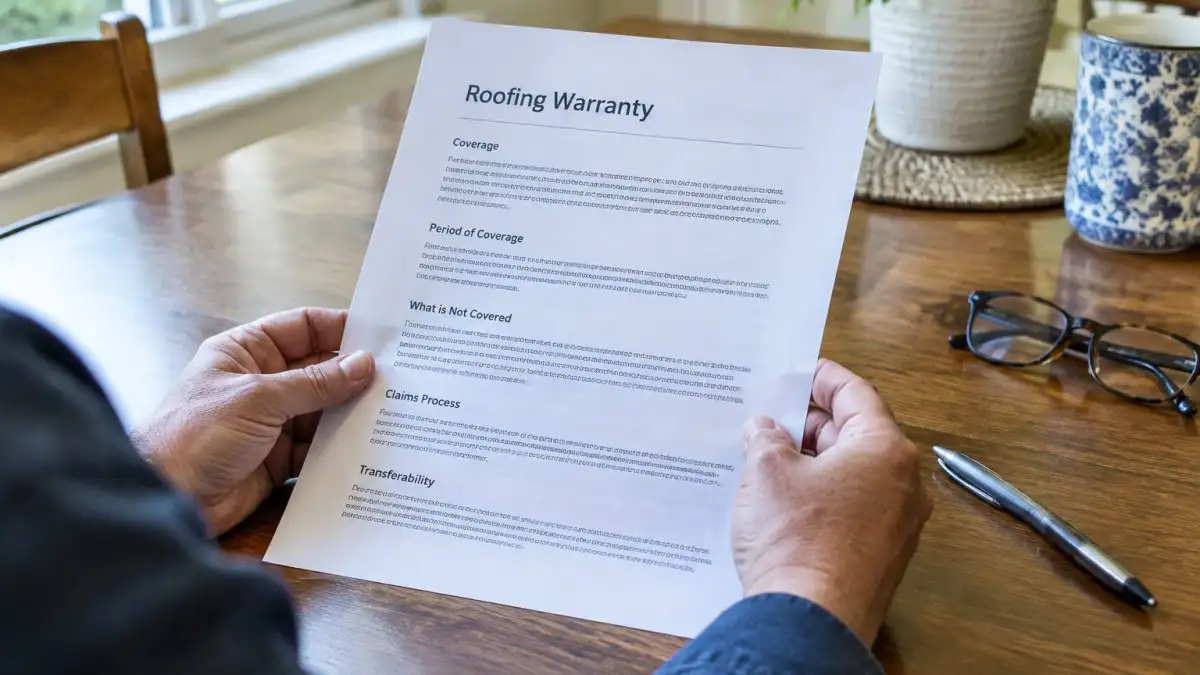
What most guides miss is that the registration deadline voids more claims than any defect. Miss it and the coverage never activates. Set a reminder the day you sign.
How Do I Find My Roof Warranty and Keep It Valid
If you cannot find your roofing warranty, check three places: the contractor who installed the roof, the closing documents from when you bought the home, and the manufacturer’s registration database. Many manufacturers let you look up a registered warranty by address or by the original installer’s name.
Keeping it valid comes down to records. Save the proof of purchase, the installation contract, and every inspection report. A roof inspection after major weather creates a paper trail that supports future claims. As a GAF certified roofing contractor, we register material warranties on the homeowner’s behalf so the coverage actually activates.
What Voids a Roof Warranty and How to Avoid It
A roof warranty can be voided by actions that break the conditions of coverage, such as installation by an unqualified installer, unauthorized repairs, or failure to meet maintenance requirements. Check the warranty document for its specific conditions.
- Use a qualified, authorized installer
- Register the warranty within the deadline
- Keep gutters clear and schedule inspections
- Never let an unapproved party repair the roof
- Save every receipt and report
Filing a Claim and Protecting Your Coverage When You Sell
Filing a claim is easier when you treat it as a file you are building: document the problem, notify the right party in writing, submit the claim package, and respond to any denial with a documented appeal.
Step 1: Document the defect before anyone touches the roof. Photograph the problem from multiple angles, note the date you first noticed it, and record the roof’s age and the installation date. Keep the photos time-stamped and store them with your warranty paperwork.
Step 2: Identify the correct party. Material defects go to the manufacturer; installation errors go to the contractor who installed the roof. If you are unsure which applies, notify both in writing and let them sort out responsibility. Keep a copy of every letter and email.
Step 3: Submit the claim package. Most manufacturers ask for proof of purchase, the installation contract, the warranty registration or certificate, photos of the defect, and a description of the problem.
Step 4: Respond to a denial in writing. If a claim is denied, ask for the denial reason in writing and cite the specific warranty language you believe applies. Appeal to the manufacturer’s warranty department, and keep the correspondence chain intact. A denial is often a documentation problem rather than a final answer.
Step 5: Know your outside options. Written warranties sit alongside state consumer-protection law and contractor licensing rules. If a contractor refuses to honor a workmanship warranty, your state licensing board and consumer-protection office are legitimate escalation paths.
Transferability when you sell. A transferable warranty can raise your home’s value at sale, but the transfer is rarely automatic. Ask three questions before listing: Does the warranty transfer to a second owner, and is it limited to the original owner? Is there a transfer deadline measured from closing, and is there a transfer fee?
Watch out: a warranty that was never registered, or one whose transfer window closed before the sale, can leave the new owner with no coverage at all, so confirm the status in writing before the buyer relies on it. For claim-related questions or to schedule a free roof inspection, contact our team or review our roofing FAQs.
A roof warranty only protects you when it is registered, documented, and backed by an installer who stands behind the work. Covenant Roofing & Restoration is a licensed Tennessee building contractor and GAF factory-certified company, and we register material warranties for you, navigate insurance claims, and put our workmanship in writing.
Frequently Asked Questions
How does a roofing warranty actually work?
A residential roofing warranty is split into two parts. The manufacturer covers defects in the roofing materials, such as shingles that crack or lose granules before their rated life. The contractor covers installation errors, like improperly nailed shingles or faulty flashing. When a leak appears, you contact the installer first. They determine whether the failure traces back to materials or labor, then route the claim to the right party. Keep your contract, proof of purchase, and registration confirmation together so either claim moves quickly.
What is the typical roof warranty length?
Warranty length varies by contractor and manufacturer, and workmanship and material coverage are often different terms. Read the stated coverage period and any proration language in the document, because a long-sounding term can still pay out less as the roof ages. Ask for the coverage period in writing for both labor and materials before you sign.
What voids a roof warranty most often?
Warranties can be voided by conditions such as repairs done by someone other than a qualified installer or skipped required maintenance. Review the warranty document for the specific conditions that apply. Storm damage itself does not void a warranty, but neglecting to document and repair it can. Keep a folder with your registration, inspection records, and receipts for any maintenance so you can prove the roof was cared for.
Can a roof warranty be transferred to a new homeowner?
Transferability depends on the specific warranty. Some are transferable and others are limited to the original owner, and any transfer conditions should be confirmed in the warranty document. If you are selling, gather the warranty documents and registration number before closing. If you are buying, ask the seller for written confirmation of transferability and submit the transfer paperwork promptly, since deadlines are often short.
Does a roof warranty cover leaks or storm damage?
A warranty covers defects, not damage. A leak caused by a manufacturing defect or an installation error is typically covered. A leak caused by hail, wind, or a fallen limb is an insurance claim, not a warranty claim. That distinction matters because filing the wrong type of claim wastes time. After a storm, photograph the damage, contact your insurer, and have a licensed contractor inspect the roof so the cause is documented accurately from the start.