Last Updated: November 19, 2026
Quick Summary
Roof maintenance is the practice of scheduled inspection, cleaning, and small repair that keeps your roof from failing on its own timetable. A workable roof maintenance checklist runs on two real inspection windows, spring and fall, plus light monthly observation. Prioritize water-intrusion prevention first, then structural and safety tasks, then cosmetic work.
- Clear gutters and downspouts in spring after the last freeze to address winter damage and loose fasteners.
- Clear leaves twice in fall, before and after leaf drop, to prevent ice dams.
- Most homeowners can safely clean gutters from a stable ladder and do ground-level inspections with binoculars.
- Leave roof walking, flashing repair, and roof penetrations to a professional.
- Check metal roof fasteners, sealant, and coating annually, since panels themselves rarely fail.
Table of Contents
- Why Roof Maintenance Matters More Than Most Homeowners Realize
- Your Seasonal Roof Maintenance Checklist
- DIY Roof Maintenance Safety: What You Can Do and What You Shouldn’t
- Spotting Problems: Shingles, Flashing, and Warning Signs
- Moss, Algae, and Overhanging Branches: Managing Organic Threats
- Attic Checks, Leaks, and Storm Damage Inspections
- Metal Roof Maintenance Tips for Long-Term Performance
- What Roof Maintenance Cost Looks Like and How to Budget for It
- Frequently Asked Questions
Why Roof Maintenance Matters More Than Most Homeowners Realize
A roof is the one building assembly that takes every hour of weather a region can deliver, and it fails quietly until it fails expensively.
The economics are not subtle. A cracked flashing boot or a clogged valley costs little to correct while it is still a maintenance item.
What most guides miss is prioritization. You do not need to do everything every season.
Your Seasonal Roof Maintenance Checklist
A workable roof maintenance checklist runs on two real inspection windows plus light monthly observation. The seasonal rhythm below assumes a climate with cold winters and warm, humid summers, which is where most storm and organic-growth damage accumulates.
| Season | Core Tasks | Frequency | Primary Risk Addressed |
|---|---|---|---|
| Spring | Clear gutters and downspouts, full visual inspection, check flashing | Once, after last freeze | Winter damage, ice dam residue, loose fasteners |
| Summer | Trim overhanging branches, watch for moss and algae | Once, plus monthly glance | Organic growth, debris load, pest access |
| Fall | Remove leaves, confirm attic ventilation before cold | Twice, before and after leaf drop | Ice dams, trapped moisture, gutter overflow |
| Winter | Visual check from ground after storms | After each significant event | Snow load, wind damage, ice dams |
A Month-by-Month Maintenance Calendar
A calendar you can actually follow looks like this:
- January-February: After any snow or ice event, check from the ground for icicles at the eaves, sagging gutters, and snow that lingers on one slope longer than the rest. Lingering snow usually means heat is escaping from the attic.
- March: Clear gutters of winter grit and shingle granules. Walk the perimeter with binoculars for lifted shingles and flashing that pulled away during freeze-thaw cycles.
- April: Full visual inspection after the last freeze. Check attic for water stains and daylight. This is the best month to schedule any professional repair before spring rain.
How to Prioritize When You Cannot Do Everything
Not every task carries the same urgency. Rank maintenance in three tiers:
- Water-intrusion prevention (do first): flashing repair, caulking penetrations, clearing gutters and valleys, sealing any breach the attic inspection reveals. These prevent the expensive interior damage.
- Structural and safety (do next): replacing missing shingles, securing loose fasteners on metal roofs, removing limbs that threaten the roof surface.
- Cosmetic and preventive (do when time allows): algae treatment, coating touch-ups, gutter guard installation.
After a severe storm, the priority order changes: document first, then address any active leak, then schedule a professional inspection before signing anything with a door-to-door contractor.
Spring: Gutters, Debris, and a Full Visual Inspection
Spring is when winter’s damage becomes visible. Start with the gutters and downspouts: clear leaves and grit, then confirm water actually exits at the ground rather than pooling against the foundation.
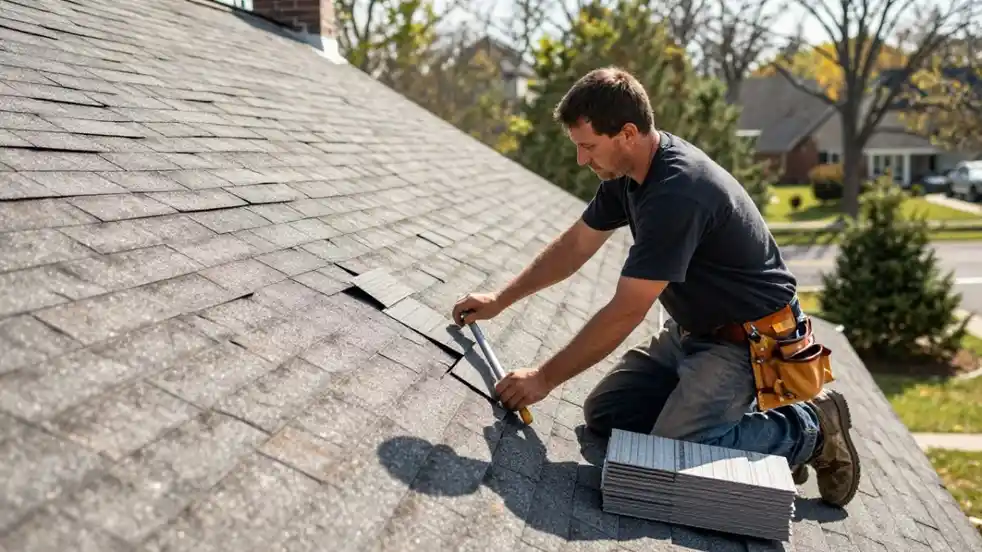
Then walk the perimeter with binoculars. You are looking for lifted or missing shingles, granule piles at the base of downspouts, and flashing that has pulled away from chimneys or walls.
Fall: Clearing Leaves Before Winter Sets In
Fall work exists to prevent ice dams. Debris left in gutters and valleys traps meltwater, which refreezes at the roof edge and backs up under shingles.
This is also the right moment to confirm attic ventilation and insulation are doing their job. For a deeper seasonal walkthrough, our guide on how to prepare your roof for winter covers ice dams, ventilation, and gutter detail in full.
DIY Roof Maintenance Safety: What You Can Do and What You Shouldn’t
Most homeowners can safely handle ground-level maintenance. Anything that requires walking the roof surface carries real risk.
Safe for most homeowners:
- Gutter cleaning from a stable ladder, with a helper footing it
- Ground-level visual inspection with binoculars
- Attic checks for water stains, daylight, and damp insulation
Leave to a professional:
- Walking the roof surface, especially above one story
- Any work near power lines or on steep pitches
- Flashing repair and roof penetrations
Pressure washing shingles can strip protective granules and may affect shingle warranties. Moss removal is best left to a qualified professional.
Ladder safety deserves its own line. Set the ladder on firm, level ground, extend it above the roofline, maintain three points of contact, and wear protective gloves.
Spotting Problems: Shingles, Flashing, and Warning Signs
A roof inspection is a structured look for specific defects, not a vague scan. Work in this order: shingle field first, then flashing and penetrations, then the attic from inside.
Missing, Cracked, and Damaged Shingles
Missing shingles are obvious. Cracked and damaged shingles are the ones homeowners overlook, and they matter just as much. Look for shingles with visible splits, curled or lifted edges, bald patches where granules have worn away, and dark granules collecting in gutters.
Isolated damage can often be repaired. Widespread granule loss across a slope usually signals the roof is near the end of its service life, and patching becomes a delaying tactic rather than a fix.
Flashing, Caulking, and Roof Penetrations
Flashing is the metal that seals roof-to-wall junctions, chimneys, skylights, and vent pipes. It is where a large share of leaks begin, because it relies on correct installation and intact sealant rather than on the shingle field.
Caulking is maintenance, not repair. Sealant dries and cracks over time, so re-caulking penetrations is a legitimate recurring task. Replacing failed flashing is not.
Moss, Algae, and Overhanging Branches: Managing Organic Threats
Organic growth is a moisture problem with a plant on top. Moss holds water against the shingle surface, lifting edges and accelerating rot underneath. Algae shows as dark streaking and is largely cosmetic, but it signals a roof that stays damp.
Tree branches create the conditions for all of it. Overhanging limbs shade the roof, drop leaves into valleys, and abrade shingle surfaces in wind.
For removal methods, our guide on how to remove moss and black streaks from your roof safely explains why soft washing outperforms scraping and pressure washing. If the goal is stopping regrowth rather than a one-time cleanup, preventing algae growth on your roof covers ventilation, trimming, and algae-resistant shingles.
Attic Checks, Leaks, and Storm Damage Inspections
The attic tells you what the roof surface hides. Look for water stains on rafters and sheathing, daylight showing through the roof deck, damp or compressed insulation, and rusted nail tips.
Storm inspections follow a different protocol. Our step-by-step guide on how to check for roof damage after a storm walks through safe inspection and claim documentation.
Watch out: signing anything from a door-to-door contractor before your insurer has inspected can complicate the claim. Document first, decide second.
Metal Roof Maintenance Tips for Long-Term Performance
Metal roofs need less frequent attention than asphalt shingles, but they are not maintenance-free. The failure points are fasteners, sealant, and coating, not the panels themselves.
- Check fastener washers for deterioration and back out loose screws
- Inspect sealant at seams, ridge caps, and penetrations annually
- Clear debris from valleys where it traps moisture against the panel
Walking a metal roof is more dangerous than it looks, particularly when wet. Panel seams and fasteners create trip points, and the surface offers no texture for traction. Visual inspection from the ground and from ladders at the eaves covers most of what you need to catch.
What Roof Maintenance Cost Looks Like and How to Budget for It
Roof maintenance cost depends on roof size, pitch, material, and how much has been deferred. Preventing water damage through consistent roof gutter maintenance tips remains the most effective way to avoid the premature, costly repairs that often lead to full roof replacement.
We do not publish fixed maintenance pricing, because a two-story steep-pitch roof and a single-story low-slope roof are not comparable jobs. For planning purposes, our average cost of roof repair pricing guide breaks down 2026 repair ranges by job type.
A Budgeting Framework You Can Actually Use
Most homeowners have no idea what to set aside for roof care. A practical framework looks like this:
- Annual maintenance allowance: Set aside an amount each year based on roof age and material. A newer asphalt shingle roof needs less; a roof past the midpoint of its service life needs more.
- Repair reserve: Keep a separate reserve for targeted repairs. A pipe boot replacement, a flashing repair, or a small shingle patch each cost a fraction of a full replacement, but they add up over a roof’s life.
- Replacement fund: If your roof is within five to seven years of its expected service life, start funding replacement now. Service life varies by material and conditions; ask a licensed contractor about the expected lifespan of your roof.
What Drives the Price Up or Down
The same maintenance task can vary widely in cost depending on:
- Roof pitch and height: Steep or multi-story roofs require more safety equipment and labor time.
- Material: Metal and tile repairs often need specialized labor and fasteners; asphalt shingles are more common and generally less expensive to service.
- Access: A roof with landscaping, fences, or tight side yards takes longer to set up.
When Maintenance Becomes a Repair
A useful rule: if a defect is isolated and caught early, it is maintenance. If it has spread across a slope or reached the sheathing, it is a repair.
A practical budgeting approach: set aside an annual maintenance allowance based on your roof’s age and material, and treat storm documentation as free insurance. Homeowners who track maintenance records may find it easier to support warranty claims.
Frequently Asked Questions
What is included in a standard residential roof maintenance checklist?
A standard roof maintenance checklist covers gutter and downspout cleaning, removal of leaves and organic debris from the roof surface, inspection of shingles for missing, cracked, or damaged areas, checking flashing and roof penetrations for gaps, looking for moss and algae growth, trimming overhanging branches, and scanning the attic for leaks, water stains, or moisture. It should also include a post-storm inspection and a note of any repairs needed. A written record of each check helps you track changes over time and supports insurance or warranty claims.
How often should a homeowner inspect their roof for damage?
Plan a visual inspection twice a year, in spring and fall, plus after any major storm with high wind or hail. From the ground, use binoculars to check the roof surface for missing shingles, sagging, or debris. If you have a metal roof, look for loose fasteners or lifted panels. Any time you notice a ceiling stain, granule buildup in gutters, or daylight in the attic, treat it as a prompt for a closer look. Professional inspections are worth scheduling annually to catch problems early.
Can DIY roof maintenance void a manufacturer’s warranty?
Yes, it can. Many shingle and metal roofing warranties require installation and repairs by qualified contractors, and walking on the roof or making improper repairs can void coverage. For example, GAF factory-certified installers follow specific requirements that protect the warranty. If you are unsure, check your warranty documents before doing any work beyond gutter cleaning and ground-level observation. For repairs, use a licensed contractor who can document the work properly.
What are the signs that a roof needs professional repair versus maintenance?
Routine maintenance handles debris, minor moss, and small caulking touch-ups. Call a professional for missing or cracked shingles across a large area, water stains on ceilings or walls, granules collecting in gutters, sagging roof lines, or pooled moisture in the attic. Storm damage, especially after hail or high wind, should be inspected by a licensed contractor who can assess insurance claim eligibility. If your roof is over 15 to 20 years old, an annual professional inspection is the safest way to plan for repairs.
How does seasonal weather impact roof maintenance requirements?
Spring brings rain and pollen, so focus on gutter clearing and checking for leaks. Summer heat can cause shingles to crack, and algae grows faster in humid conditions. Fall is the critical season for removing leaves and organic debris before winter. In colder areas, snow and ice dams put stress on the roof edge, so keep gutters clear and watch for ice buildup. Storm season, whenever it hits your region, calls for a prompt inspection. Adjusting your checklist to the season keeps small issues from becoming expensive repairs.