Starting a roofing project often feels like listening to a conversation in a different language. When a contractor mentions flashing, squares, or ice and water shields, it is easy to feel lost, but these terms describe the very things keeping your family dry. Understanding basic roofing terminology is the best way to ensure you are getting exactly what you pay for without any sticker shock when the final bill arrives. In Greeneville, where our homes face everything from humid Appalachian summers to freezing winter winds, knowing the difference between a simple shingle and a full roofing system is vital. This guide breaks down the industry jargon into simple, everyday English so you can talk to your roofer with confidence and make the best decisions for your property.
Table of Contents
Structural Terminology: The Bones of Your Roof
Before any shingles can go on, your roof needs a solid skeleton. The bones of your roof determine how much weight it can hold, which is especially important when we get heavy, wet snow here in East Tennessee. If the structural components are failing, even the most expensive shingles in the world wont prevent your roof from sagging or leaking. Understanding these terms helps you understand what is happening in your attic and why a roofer might tell you that your decking needs to be replaced before they can start the actual install. Our roof replacement services always begin with a Tear-Off to inspect the underlying Decking and Rafters, ensuring your new roof has a solid foundation.
Decking (Sheathing)
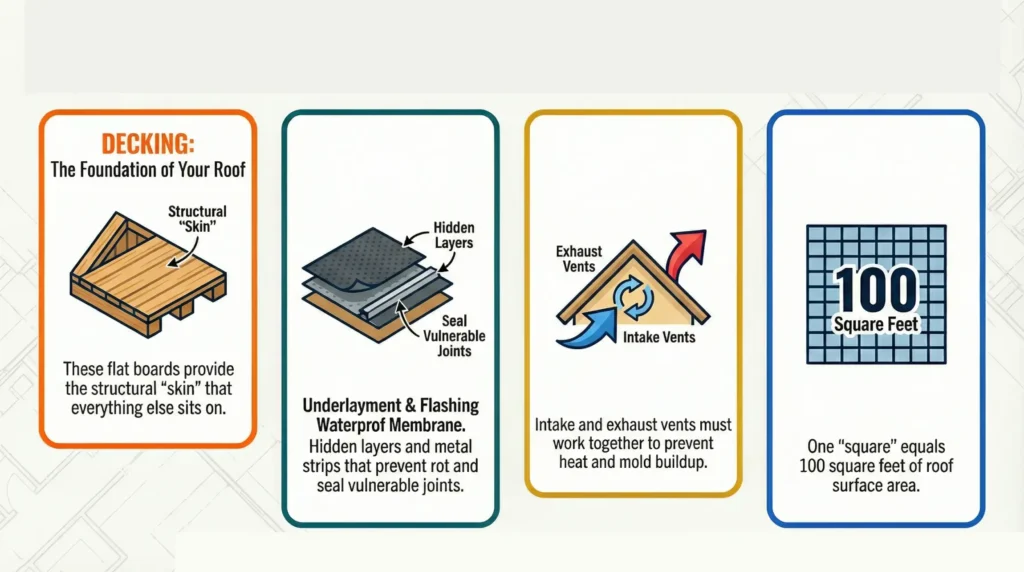
The decking is the structural base of your roof and supports every other roofing material above it. Typically made from plywood or oriented strand board (OSB), decking provides the foundation for underlayment, shingles, and protective systems. A strong and well-maintained deck is critical for the overall durability of the roof. Weak or rotted decking can compromise the entire roofing system, allowing water to seep in and potentially causing damage to the attic or interior of the home. Regular inspections by a professional roofer, especially before winter, ensure the decking remains solid and ready to handle snow loads common in Greeneville, TN. Our roof replacement services always begin with a Tear-Off to inspect the underlying Decking and Rafters, ensuring your new roof has a solid foundation.
Rafters vs. Trusses
While both support the roof, they are built differently. Rafters are the traditional sloped beams that run from the peak of your roof down to the eaves. They are usually cut on-site and allow for more open attic space. Trusses, on the other hand, are prefabricated triangular structures that are delivered to the site ready to install. Trusses are often stronger and can span larger distances without needing interior support walls. If you are looking to renovate your attic into a living space, knowing whether you have rafters or trusses is the first thing a contractor will ask.
Pitch and Slope
Although people use these words interchangeably, they describe the steepness of your roof in slightly different ways. Slope is the rise over run, how many inches the roof goes up for every 12 inches it goes across. For example, a 4:12 slope means the roof rises 4 inches for every foot of horizontal distance. Pitch is a more complex mathematical fraction of the entire span. Why does this matter to you? Steeper roofs shed water and snow much faster, but they are also more dangerous to walk on, which often means the labor cost for a high-pitched roof will be a bit higher.
Waterproofing & Underlayment Lingo
Shingles are just the pretty part of the roof that people see from the street. The real work of keeping water out happens underneath the surface. The waterproofing layers are the unsung heroes of your roofing system. If a roofer cuts corners on these hidden materials to give you a lower price, you might not notice a problem for a year or two, but eventually, the lack of a proper barrier will lead to rot and mold. In Greeneville’s high-humidity climate, these layers are your home’s most important defense. Often, a leak isn’t caused by the shingles but by a failed Pipe Boot or Flashing; a roof repair can reseal these Penetrations and extend the life of your system.
| Term | What It Is | Why You Need It |
| Underlayment | A water-resistant felt or synthetic sheet | Secondary layer of protection under shingles |
| Ice & Water Shield | A sticky, rubberized, waterproof membrane | Stops leaks from ice dams and wind-driven rain |
| Flashing | Thin metal strips (aluminum or steel) | Seals joints around chimneys and valleys |
| Drip Edge | L-shaped metal at the roofs edge | Keeps water from rotting the edge of the wood deck |
Underlayment and Ice and Water Shield
Underlayment is the first layer of protection applied to the bare wood decking. In the past, this was almost always felt paper (paper soaked in asphalt), but today, most high-quality roofs use synthetic underlayment because it is tougher and doesnt tear in high winds. For the most vulnerable spots, like the valleys where two roof sections meet or the eaves where ice builds up, we use a specialized product called Ice and Water Shield. This is a thick, sticky membrane that glues itself to the wood, creating a totally waterproof seal that even standing water cannot get through.
Flashing and Pipe Boots
Flashing refers to the metal pieces installed anywhere the roof surface is interrupted, such as where it meets a chimney, a skylight, or a wall. It is designed to shed water away from these seams. Pipe boots (or collars) are a specific type of flashing that slides over the plumbing vent pipes sticking out of your roof. These are some of the most common leak points because the rubber or metal can crack over time. When we perform a tune-up, the flashing and boots are the first things we check because a simple reseal here can prevent a major headache later.
The Anatomy of a Shingle System
When you look at a roof from the sidewalk, you are mostly seeing the shingles, but even this top layer has its own specific vocabulary. In Greeneville, asphalt shingles are the most popular choice because they are durable and cost-effective. However, not all shingles are created equal. You will hear terms like dimensional or granules that describe how the shingle is built and how it will perform over the next twenty or thirty years. At Covenant Roofing & Restoration, we want you to know exactly what you are putting on your home so you can balance curb appeal with long-term protection.
Architectural vs. 3-Tab
These are the two most common styles of shingles you will see on Tennessee homes. 3-Tab shingles are the older, flat style that consists of a single layer with cutouts that make them look like three separate pieces. Architectural shingles, also called Dimensional or Laminate shingles, are made of multiple layers of material bonded together. They are thicker, heavier, and have a textured, wood-shake look. Most homeowners today choose architectural shingles because they offer much better wind resistance and generally come with longer warranties.
Starter Strip and Ridge Caps
A shingle roof is built from the bottom up. The very first row of shingles at the eaves is called the Starter Strip. This is a specialized shingle with a heavy-duty adhesive designed to lock down the first row so the wind cannot get underneath and peel the roof back. At the very top of the roof, where the two slopes meet, we install Ridge Caps. These are thicker, pre-bent shingles that cover the peak. They are designed to withstand the most intense sun and wind exposure while providing a clean, finished look to the roof’s silhouette.
Granules: The Protective Surface
If you look closely at an asphalt shingle, you will see it is covered in tiny, sand-like stones. These are called Granules. They aren’t just for color; their main job is to protect the asphalt underneath from the sun’s UV rays. Without granules, the asphalt would dry out and crack in just a few years. Finding a pile of granules in your gutters is often the first sign that your roof is nearing the end of its life, as it means the protective armor is finally wearing away.
Roof Edge & Exterior Trim Terms
The edges of your roof are where the roofing meets the siding. These components are critical because they protect the wood framing of your house from moisture and pests. In our region, squirrels and birds love to try to find ways into attics through gaps in the trim. Understanding these terms helps you identify where a leak or a pest entry point might be located. These parts are also a major part of your home’s aesthetic, providing the trim that defines your house’s style.
Eaves vs. Rake
The Eave is the horizontal edge of the roof that hangs over the exterior walls. This is where your gutters are attached. The Rake is the sloped edge of a gable roof that runs from the eave up to the peak. While they look similar, they require different types of flashing and trim. In Greeneville, we pay close attention to the Rake Edge because wind-driven rain from mountain storms often hits these sloped edges with high pressure, requiring a tight metal seal to prevent wood rot.
Soffit and Fascia
The Fascia is the vertical board that runs along the edge of the roof; it is the face that your gutters are nailed to. The Soffit is the underside of the roof overhang that you see when looking up from the ground. Together, they create a finished look and seal off your attic. However, they aren’t just for decoration. The soffit often contains vents that allow cool air to enter your attic, making it a functional part of your home’s breathing system.
Ventilation & Airflow Vocabulary
A well-ventilated attic is essential for preventing winter damage. Ridge vents at the peak of your roof allow hot air to escape, while soffit and eave vents draw cool air in, creating a balanced airflow. This circulation keeps your roof temperature even, reducing the chances of snow melting unevenly and forming ice dams at the eaves. Ice dams occur when attic heat melts snow on the upper roof, which then refreezes at colder eaves, causing water to back up under shingles. We evaluate your ridge and soffit vents, ensuring that airflow is continuous and effective, which helps prevent costly ice dam damage.
Intake vs. Exhaust
A balanced ventilation system requires two parts. Intake vents are located at the bottom of the roof (usually in the soffit) and pull cool, fresh air into the attic. Exhaust vents are located at the top of the roof (usually at the ridge) and allow hot, moist air to escape. Think of it like a chimney; for the air to move, it has to have an entry point and an exit point. If you only have one or the other, the air stays trapped, which can cook your shingles from the inside out.
Ridge Vents and Baffles
A Ridge Vent is a low-profile vent that runs the entire length of the roof peak. It is covered by ridge cap shingles, so it is almost invisible from the ground, but it provides constant exhaust for rising heat. To make sure the intake air can reach the , we use Baffles (or rafter vents). These are plastic or foam channels installed in the attic between the rafters. They prevent your insulation from sliding down and blocking the soffit vents, ensuring that the airflow stays open and clear.
Common Roofing Measurement & Pricing Terms
When you receive an estimate from a contractor, you might see terms that don’t match the square footage of your home. Roofing has its own set of industry-standard measurements. Understanding these terms is the best way to compare quotes fairly. If one contractor quotes you for 25 squares and another quotes for 30, you need to know if they are measuring the same thing or if someone is including a waste factor that the other missed. Being familiar with these terms ensures you are comparing apples to apples. Understanding Waste Factors and Squares can help you decide between a roof replacement vs. repair when comparing the long-term value of each option.
A Square
In the roofing industry, a square is the most common unit of measurement. One square is equal to 100 square feet (a 10 x 10 area). Contractors use this because it simplifies the math for large areas. For example, if your roof surface area is 2,400 square feet, your contractor will tell you that your roof is 24 squares. This measurement covers the actual surface of the roof, not the footprint or floor space of your house. Because of the slope and overhangs, the roof squares will always be a higher number than the square footage of your home’s interior.
Waste Factor
No roof is a perfect rectangle. Because shingles have to be cut to fit into valleys, around chimneys, and along the rakes, there is always some material that cannot be used. This is called the Waste Factor. Typically, a contractor will add 10% to 15% to the total square footage to account for these cuts and for the shingles used as starters and ridge caps. If your roof has many dormers and complex angles, the waste factor will be higher. Seeing this on an estimate is a sign of a professional who is planning for a complete job.
Tear-Off vs. Roof-Over
A Tear-Off means the contractor will remove every layer of old roofing down to the bare wood decking before installing the new system. A Roof-Over (or recovery) is when new shingles are nailed directly over the old ones. While a roof-over is cheaper, it is often a bad idea in the long run. It adds double the weight to your structure, traps heat, and prevents the roofer from seeing if the wood decking underneath is rotted. Most modern building codes and manufacturer warranties require a full tear-off to ensure the new roof performs correctly.
Frequently Asked Questions
What is the most common roofing term for a leak?
In the industry, a leak is often traced back to a penetration failure. This refers to any spot where something (like a pipe or chimney) pokes through the roof. If the flashing or boot at that penetration fails, you get a leak.
What is the board under the shingles called?
The board is called the decking or sheathing. It is the wooden foundation that provides the structural surface for shingles and underlayment.
What does dry-in mean in roofing?
Dry-in refers to the stage of the project where the underlayment and flashing are installed, making the house watertight even if the shingles haven’t been put on yet. This is a critical milestone during rainy Tennessee seasons.
What is the difference between a hip and a gable roof?
A Gable roof has two sloping sides that meet at a ridge, forming a triangle at the end walls. A Hip roof has slopes on all four sides that meet at the corners (hips) and a central ridge.
Why Clear Communication Matters: The Covenant Promise
At Covenant Roofing & Restoration, we believe that you shouldn’t need a construction degree to understand your own home. We take pride in translating industry jargon into clear, actionable information. When we provide an estimate for a Greeneville homeowner, we walk you through every term, from the drip edge to the ridge vent, so you know exactly how your investment is being protected. Our Covenant Promise is to provide a no-surprises experience where the only thing we leave behind is a beautiful, long-lasting roof.