

Last Updated: November 12, 2026
Quick Summary
To file a roof insurance claim, document all damage with photos and dated notes, review your policy and filing deadline, then report the loss to your insurer and open a claim number. You then submit supporting documentation, meet the adjuster, review the settlement, and complete repairs.
- Photograph each roof slope from the ground and never climb up to inspect damage yourself.
- Confirm your policy’s loss reporting deadline and proof-of-loss deadline in writing and put them on your calendar.
- On a replacement cost policy, the insurer holds back depreciation until you submit the final invoice.
- Ask for a supplemental claim if the adjuster’s scope misses damage your contractor documented.
- A contractor who offers to waive your deductible is a red flag and deductible waiving is illegal in many states.
Table of Contents
- Understanding the Roof Insurance Claim Process
- Step 1: Document the Damage Before You Call Anyone
- Step 2: Review Your Policy and Know How Long You Have to File a Claim for Roof Damage
- Step 3: Report the Damage and File Your Claim
- Step 4: Build Your Roof Damage Insurance Claim Documentation
- Step 5: What to Say to a Roof Insurance Adjuster During the Inspection
- When a Claim Is Denied or the Estimate Comes in Low
- Schedule Your Roof Inspection with Covenant Roofing & Restoration
- Frequently Asked Questions
Understanding the Roof Insurance Claim Process
A roof insurance claim is a formal request asking your homeowners insurance to pay for storm-related roof damage.
Here is the part most guides get wrong. Your insurer does not send money because damage looks bad. They pay because you proved the damage happened, proved it is covered, and filed inside your policy’s deadline.
The process generally follows this order:
- Document the damage
- Review your policy and filing deadline
- Report the loss and open a claim
- Submit supporting documentation
- Meet the adjuster
Below, we break down each step so you know exactly what to do and when. The Tennessee-specific claim guide is worth reading alongside this, because state rules on matching and depreciation change how your settlement is calculated.
Step 1: Document the Damage Before You Call Anyone
Document roof damage with photos, video, and dated notes before you contact your insurer or a contractor. This record becomes the backbone of your entire claim.
Start outside, on the ground. Use your phone’s zoom instead of climbing up.
- Wide shots of each roof slope from the yard
- Close-ups of missing, cracked, or lifted shingles
- Photos of dents on gutters, vents, and downspouts
- Any interior stains on ceilings or walls
- A short video panning the full roofline
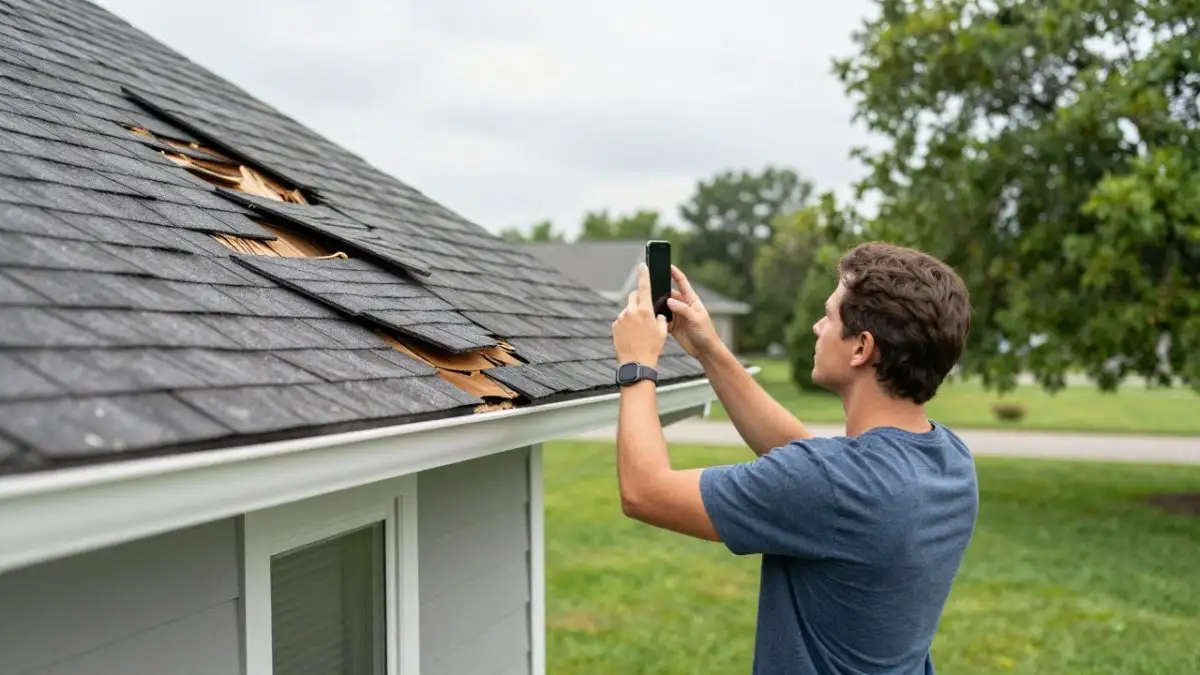
Do not throw away damaged materials. Our guide on safe roof damage checks shows how to inspect without getting on the roof, and this storm damage documentation walkthrough covers exactly what to capture for roof, siding, and personal property.
Step 2: Review Your Policy and Know How Long You Have to File a Claim for Roof Damage
How long you have to file a claim for roof damage depends on your policy and your state’s rules, so read your declarations page before you call anyone. Missing a reporting deadline can sink an otherwise valid claim.
Look for five things:
- Covered perils: Does your policy list wind and hail, or does it exclude them?
- Deductible: The amount you pay before insurance kicks in. On a roof claim this is often a separate percentage deductible, not a flat dollar amount.
- Replacement cost value (RCV) vs. actual cash value (ACV): RCV pays to replace; ACV pays depreciated value.
- Recoverable depreciation: On an RCV policy, the insurer typically holds back depreciation on the first check and releases it after the work is complete and invoiced.
- Exclusions: Wear and tear, maintenance neglect, and aging are typically not covered.
How the settlement math actually works
Many homeowners are surprised by the gap between the first check and the final cost. On an RCV policy, the process often works like this:
- The adjuster calculates the replacement cost of the roof, then subtracts depreciation to arrive at actual cash value.
- The insurer sends an initial payment for the ACV amount minus your deductible.
- You hire a contractor and complete the work.
- You submit the final invoice, and the insurer releases the recoverable depreciation, up to the replacement cost figure.
On an ACV policy, step 4 never happens. You receive the depreciated amount and cover the rest yourself. That is why the same storm and the same roof can produce very different out-of-pocket costs depending on which policy form you bought.
Percentage deductibles deserve their own warning. For example, a percentage wind/hail deductible can add a significant out-of-pocket amount before the insurer pays anything, separate from your standard deductible.
Watch out: a roof past its expected lifespan may get a reduced payout or a denial even after a real storm, because insurers apply depreciation schedules and maintenance exclusions aggressively on older roofs.
Deadlines to confirm in writing
- The policy’s deadline for reporting a loss (often stated in days, not months)
- Any state-mandated claim handling timeline your insurer must follow
- The deadline to submit a proof of loss form, if your insurer requires one
- The window for filing a supplemental claim after the initial settlement
Put those four dates on your calendar the day you open the claim. The proof-of-loss deadline is one that homeowners often miss, because it can arrive by mail while everyone is focused on the adjuster visit.
Step 3: Report the Damage and File Your Claim
Report the damage to your insurer as soon as you have photos and your policy details in hand. Call their claims line, give a clear date of loss, and open a claim number.
Have these ready before you dial:
- Your policy number
- The date of loss
- A short damage description
- Your photo inventory
Write down the claim number and the name of the person you speak with. Ask how to submit photos and whether they want a contractor’s estimate first.
Step 4: Build Your Roof Damage Insurance Claim Documentation
Roof damage insurance claim documentation should be organized, dated, and easy for an adjuster to follow. A clean file speeds up approval and reduces back-and-forth. A messy one invites questions and delays.
Build a simple claim file:
- A cover sheet with policy number, claim number, and date of loss
- Photos grouped by roof slope and labeled
- Receipts for temporary repairs
- A written damage inventory by area
- Your contractor’s inspection report and repair estimate
A professional inspection report can help document damage for your claim file. We recommend an inspection before you finalize your claim file. Watch out: never sign a contract or authorize permanent repairs before your claim is settled, or you may lose use on the payout.
Step 5: What to Say to a Roof Insurance Adjuster During the Inspection
What to say to a roof insurance adjuster matters, but what you avoid saying matters more. Maintaining a clear record of specific impacts is essential for your claim, a process often streamlined by Public Adjusters Atlanta when they help homeowners properly document hail damage on roof for insurance.
Keep it simple:
- Describe the damage in plain terms: “Shingles are missing on the south slope.”
- Point to your photos and inspection report.
- Ask what they are measuring and how they are calculating the settlement.
- Avoid guessing at cause. Say “I believe this came from the storm” rather than stating it as fact.
- Do not accept an on-the-spot number without reviewing it.
Have someone with you if you can, and take your own notes during the visit. If the adjuster’s scope misses damage your contractor documented, ask how to submit a supplemental claim. That is a normal part of the process, not a confrontation.
When a Claim Is Denied or the Estimate Comes in Low
A denial or a low estimate is not the end of the claim. Insurers sometimes miss damage, apply depreciation you can recover, or misread the cause. You have options, and using them is routine.
Start with the denial letter. It usually states the reason, such as wear and tear or an excluded peril. Read it closely, because the stated reason tells you which response fits.
If the estimate is low but the claim is approved
A low estimate is usually a scope problem, not a coverage problem. The adjuster may have measured fewer squares, skipped a slope, or priced the job at a lower-grade shingle than your roof actually has.
- Request the adjuster’s report and photos, plus the measurement report.
- Compare line by line against your contractor’s estimate: squares, ridge and hip length, valleys, flashing, drip edge, underlayment, and disposal.
- Photograph anything the adjuster’s scope missed, with a tape measure or chalk mark in frame for scale.
- Submit the supplement in writing with the contractor’s line-item estimate attached.
- Ask for a re-inspection with your contractor present if the gap is large.
Watch out: a contractor who offers to “handle everything” and waives your deductible is a red flag, and deductible waiving is illegal in many states.
If the claim is denied
Work through the stated reason in order:
- Cause dispute. If the insurer says the damage is wear and tear rather than storm, your evidence is the test square, soft-metal dents on vents and gutters, and matched shingle damage on adjacent slopes. Ask for a re-inspection with your contractor present.
- Coverage dispute. If the insurer cites an exclusion, ask for the exact policy language and the page number. Compare it against your declarations page.
- Deadline dispute. If the denial cites a late report, gather your phone records, emails, and any contractor invoice showing when you first noticed and reported the damage.
The appraisal clause
Most homeowners policies include an appraisal provision that few homeowners ever use. If you and the insurer disagree on the amount of loss, either side can demand appraisal. Each side hires an independent appraiser, the two appraisers pick a neutral umpire, and an agreement between any two of them sets the amount. Appraisal resolves valuation disputes, not coverage disputes, so it will not overturn a denial based on an exclusion.
When to bring in professional help
If the denial stands after a re-inspection and a written appeal, consider a public adjuster or an attorney who handles insurance disputes. A public adjuster works for you rather than the insurer, and fees are typically based on a percentage of the settlement.
Keep every letter, email, and photo in one folder throughout. If the dispute escalates, that file is your case.
Schedule Your Roof Inspection with Covenant Roofing & Restoration
You do not have to sort through policy language, adjuster reports, and deadlines alone. Covenant Roofing & Restoration is a licensed Tennessee building contractor and GAF factory-certified company, and insurance claim navigation is one of our specialties.
Our team handles both shingle and metal roofing systems. You can book storm damage restoration and a free inspection or contact our team to get started.
Storm damage will not wait, and neither should your claim.
Frequently Asked Questions
Will my homeowners insurance premium go up if I file a roof insurance claim?
A single weather-related claim, such as hail or wind damage, usually will not raise your premium on its own because the damage was not your fault. However, filing multiple claims in a short period can flag your policy at renewal. Before you file, ask your agent whether the damage exceeds your deductible. If the repair cost is close to or below the deductible, paying out of pocket often protects your rate better than filing.
How long do I have to file a claim for roof damage?
Most policies require you to report damage promptly, often within a year of the date of loss, though some states set their own deadlines. Waiting can weaken your claim because the insurer may argue the damage worsened from neglect. Report storm damage within days of discovery. Check your policy’s duties-after-loss section for the exact language that applies to you.
What should I avoid saying to a roof insurance adjuster?
Do not guess at the cause of damage, speculate about the roof’s age, or say the roof was already worn out. Avoid phrases like it has been leaking for months or I have not been on the roof in years, since these suggest deferred maintenance. Stick to facts: what you observed, when you noticed it, and the documentation you collected. Let your contractor speak to the technical condition of the roof.
Is it smart to submit an insurance claim for your roof?
File when the damage is clearly from a covered peril and the repair estimate exceeds your deductible by a meaningful margin. For small issues near the deductible amount, paying directly often makes more financial sense. Storm damage from hail or wind is usually worth claiming. Wear and tear, age, and maintenance issues are excluded, so a claim for those will be denied and may still count against you.